
Your Under-Eye Bags Are Not a Moisture Problem — They Are a Structural One, and Almost Nobody Sells You the Right Fix
A beauty editor who spent eleven years and something close to four thousand dollars on eye cream explains what finally shifted her under-eyes in ninety seconds — and why hydration was never going to do it.
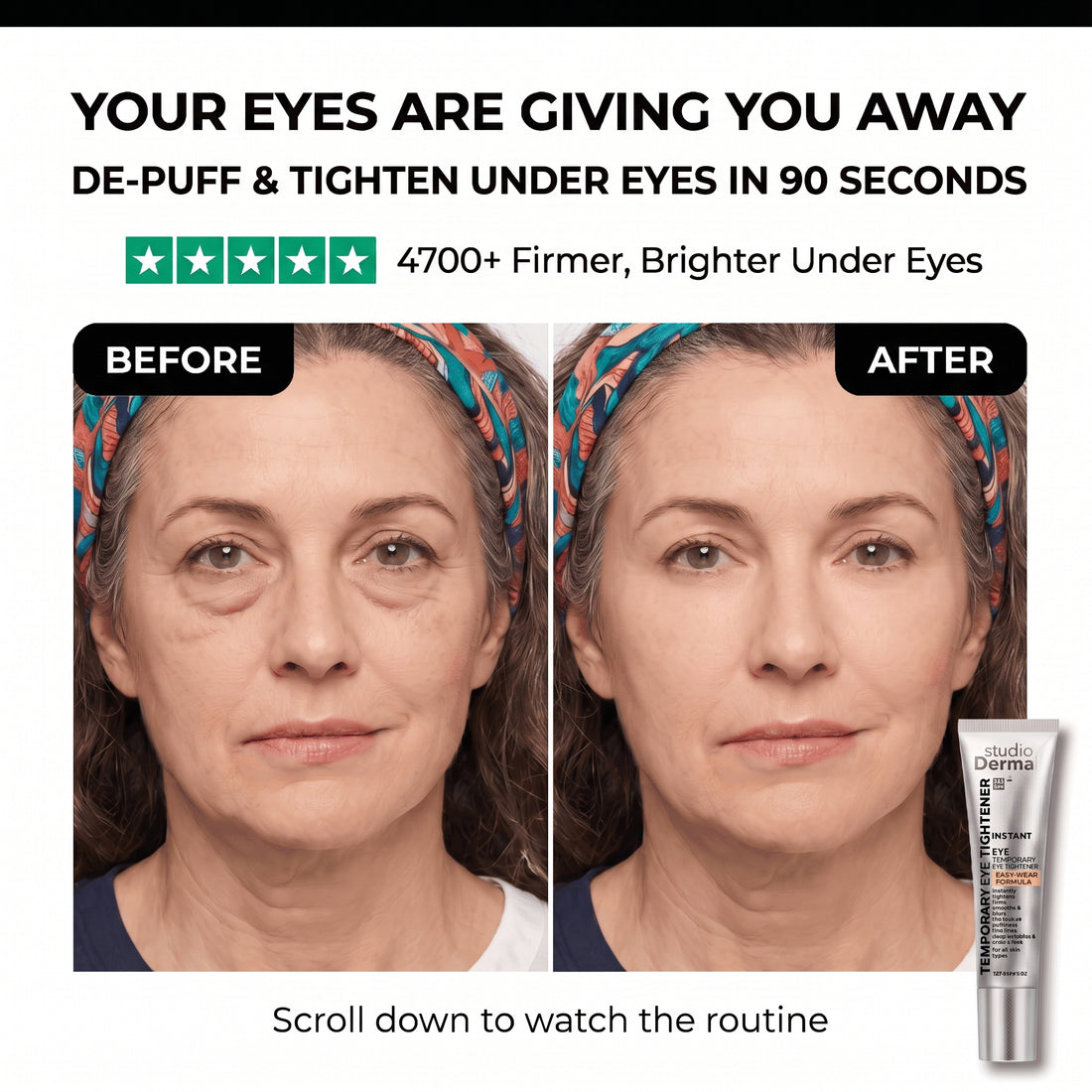
Let me describe a morning, and I want you to tell me honestly whether it belongs to you.
You wake up before the alarm. You go to the bathroom, you turn on the light, and there is a half-second where you look at your own face and something in your chest drops. Not because anything is wrong, exactly. Because the person in the mirror looks like she has been awake for three days, and you slept seven hours.
There is a soft ridge sitting under each eye. Not a shadow — you could fix a shadow. A ridge. It has weight. When you press it gently with a fingertip it dents and then takes a moment too long to come back.
Below it there is a groove, and the groove is darker than the rest of your face, and no amount of sleep, water, cucumber, or expensive serum has ever made it go away for longer than about forty minutes.
And when you smile — properly smile, the way you do at someone you love — the skin at the outer corner does not fold into one clean line the way it used to. It gathers. Dozens of tiny creases, close together, like tissue paper that has been unwrapped and smoothed back down. Crepe. That is the word for it, and once someone says it to you, you cannot unsee it.
So you do what we all do. You put concealer on it. And within ninety minutes the concealer has slid into the groove and settled there, and now the groove is not just dark, it is outlined. You have drawn attention to the exact thing you were trying to hide.
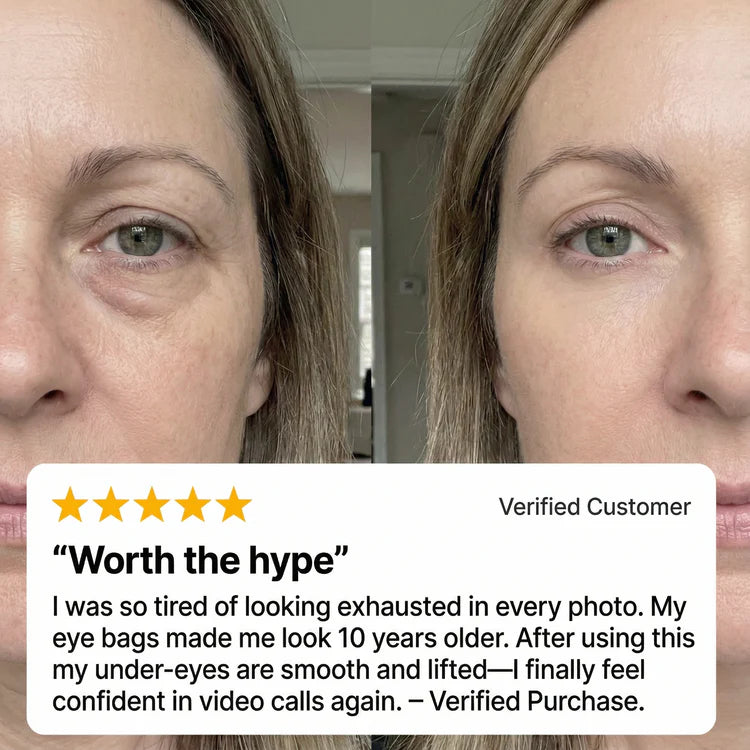
And here is the part that made me angry enough to spend six months looking into this properly: every single person you ask gives you a different answer, and none of them are useful.
Your friend says drink more water. Your mother says it is genetic, we all have them, look at your grandmother. The woman at the counter says you need a richer cream, and hands you something in a heavy glass jar for eighty-two dollars. A cosmetic doctor says filler. Another says surgery, eventually. And a dermatologist, if you can get an appointment, will tell you — correctly, but unhelpfully — that it is “multifactorial.”
Eleven years. Roughly four thousand dollars. I am a beauty editor; this is literally my job. And I still could not fix my own eyes.
Then I stopped asking what to put on them and started asking what was physically happening to them. That question changed everything.
Under-eye bags are not a hydration failure. They are a mechanical failure — skin that has lost its recoil, holding fluid it can no longer push back out. You cannot moisturise a structural problem away.
The Photographs That Finished Me Off
This part is personal, and I am including it because otherwise you will assume I am just another writer paid to be enthusiastic about a tube of something. I was not enthusiastic. I was embarrassed.
Last spring my closest friend got married. I spent an unreasonable amount on the dress. I had my hair done. I did my own makeup because I have done it professionally and I trust myself with a brush more than I trust most people.
The photographer sent the gallery three weeks later. Four hundred and sixty images. I went through them once, quickly, and then I closed the laptop and sat there for a while.
In every single photograph where I was not looking directly at the lens, the light came in from the side and caught the ridge under my eyes and turned it into a small dark crescent. I looked tired. Not older — I have no particular problem with looking my age — tired. Depleted. Like someone who was having a hard year.
I was not having a hard year. I was having a lovely year. My face just was not reporting it accurately any more.
And the thing that stung was that I had, by that point, spent over a decade buying the solution. Here is the actual accounting, because I went back through my email receipts and added it up. It is not a comfortable number.
Prestige eye creams — nine years
Retinol at night, peptide gel in the morning, a “ceramide recovery” balm for winter. I was diligent in the way only someone who writes about this for a living can be. Nine jars, give or take, at an average of eighty-two dollars. What changed? The fine crepe softened slightly in the first three weeks and then stopped. The ridge did not move at all. It cannot — nothing in the jar was designed to lift anything.
Roughly $740A cosmetic clinic consultation
Two hundred and fifty dollars for twenty minutes and a quote. Tear-trough filler, one syringe per side, between six hundred and fourteen hundred dollars, repeated every six to twelve months forever. He was honest about the risks — bruising, puffiness while it settles, the possibility of it migrating and making the area look heavier than when you started. I said I would think about it. I am still thinking about it.
$250 spent · $1,400+ per round declinedTwelve lymphatic drainage facials
A hundred and twenty dollars each, once a fortnight for six months. And they genuinely worked — for about a day and a half. Then the fluid came back, because nothing about the appointment changed the reason the fluid was pooling there in the first place. I was renting a result, not buying one.
$1,440The drawer of things that did nothing
Cooling metal wands. Hydrogel patches by the box. Caffeine ampoules. Two LED masks. A jade roller I kept in the fridge like an idiot. A “de-puffing” device that vibrated. Four years of small purchases, each one about forty dollars, each one bought at eleven at night after looking in a mirror.
Roughly $1,900What Is Actually Happening Under There
I want to explain this properly, because once you understand the mechanics, every failed purchase in your own bathroom cabinet suddenly makes sense.
The skin under your eye is about half a millimetre thick. The skin on your cheek is roughly four times that. It has almost no oil glands, very little fat cushioning it, and a thin, sparse scaffold of collagen and elastin holding it taut across the socket.
That scaffold is what gives young under-eye skin its snap. Press it, it springs straight back. It is a trampoline.
From the mid-thirties onward, three things happen at once, and they compound:
1. The scaffold loosens
Collagen and elastin production slows. The skin across the socket stops being a taut trampoline and starts being a hammock. It still covers the same area — it just no longer holds tension across it.
2. The fat pad shifts forward
A small cushion of fat sits behind that skin, held back by a thin membrane. As the membrane weakens with age, the cushion edges forward and presses outward. That is the ridge. That is the literal, physical “bag” — and it is why no cream on earth can flatten it.
3. Fluid stops draining overnight
Lying flat for eight hours lets fluid settle in the loosest tissue on your face. Young skin has enough recoil to push it back out within twenty minutes of standing up. Slack skin does not. So the puffiness that used to vanish by the time you had brushed your teeth now lasts until lunchtime — and eventually stops leaving at all.
Loose skin traps fluid. Trapped fluid stretches the skin further. Stretched skin gets looser. It is a small, quiet loop, and it runs every single night while you sleep.
I started calling it the slack window — the period where the skin has lost tension but has not yet lost its ability to be pulled taut again. And here is the important part: a slack window can be closed. A collapsed one cannot.
Why “It Is Not That Bad Yet” Is the Most Expensive Sentence in Skincare
Almost nobody catches this early, because it arrives so slowly. Here is the progression, and I would ask you to be honest about which line you are on.
Stage one — where most readers are
Puffiness on waking that has faded by mid-morning. Faint crepe at the outer corner when you smile. Concealer still sits reasonably well. You notice it, you shrug, you get on with your day.
Stage two — eighteen months to five years later
The shadow no longer fades. It is there at nine in the morning and it is there at nine at night. Concealer creases within the hour. You start choosing photographs based on which side the light came from, and you begin quietly avoiding the front-facing camera.
Stage three — the fixed groove
The crease is no longer an expression that comes and goes. It is a permanent line etched into slack tissue, and the skin no longer springs back when you press it, because there is nothing left to spring. At this point topical products cannot pull it taut, and the honest options are surgical or injectable.
I am not writing that to frighten anyone. I am writing it because I sat at stage two for four years telling myself it was fine, and stage two is exactly where this is most fixable and most ignored.
Free shipping · money-back guarantee · no subscription
Why Everything You Have Bought Has Let You Down
None of these products are frauds. They simply do a different job to the one you bought them for. Here is the honest breakdown.
Eye cream
An eye cream adds water and oil to the surface layer. Hydrated skin does look plumper, and fine dehydration lines do soften — genuinely. But hydration cannot create tension, and tension is the entire problem. Asking a moisturiser to lift a slack membrane is like asking furniture polish to fix a sagging shelf.
Caffeine gels, cold spoons, chilled rollers
These constrict the blood vessels for a while, which does temporarily reduce puffiness. The effect reliably lasts twenty to forty minutes. It is a genuinely useful trick before a meeting. It is not a treatment, and everyone selling it knows that.
Concealer
Concealer is pigment. It changes colour, not shape. On a flat surface it works beautifully. On a raised ridge with a groove beneath it, the product migrates into the groove within the hour and lands a hard edge exactly where you least want one. Most women I know are not making their under-eyes lighter — they are making them more defined.
Tear-trough filler
This one does address structure — it fills the hollow so the ridge above it reads as less prominent. It also costs six hundred to fourteen hundred dollars per round, needs redoing every six to twelve months, and the under-eye is the single least forgiving place on the face for filler. Ask any injector about migration and watch their expression change.
Lower blepharoplasty
Surgery removes or repositions the fat pad and trims the excess skin. It works. It also runs from four thousand to nine thousand dollars, involves a fortnight of visible bruising, carries real surgical risk in a delicate area, and cannot be undone if you dislike the result. That is a very large door to walk through for a ridge you first noticed on a Tuesday.
Look at that list and notice the gap sitting in the middle of it. On one side, products too weak to change the shape of anything. On the other, procedures that change it permanently for thousands of dollars. There is nothing in between.
That gap is what I went looking for.
What Finally Worked: A Film, Not a Cream
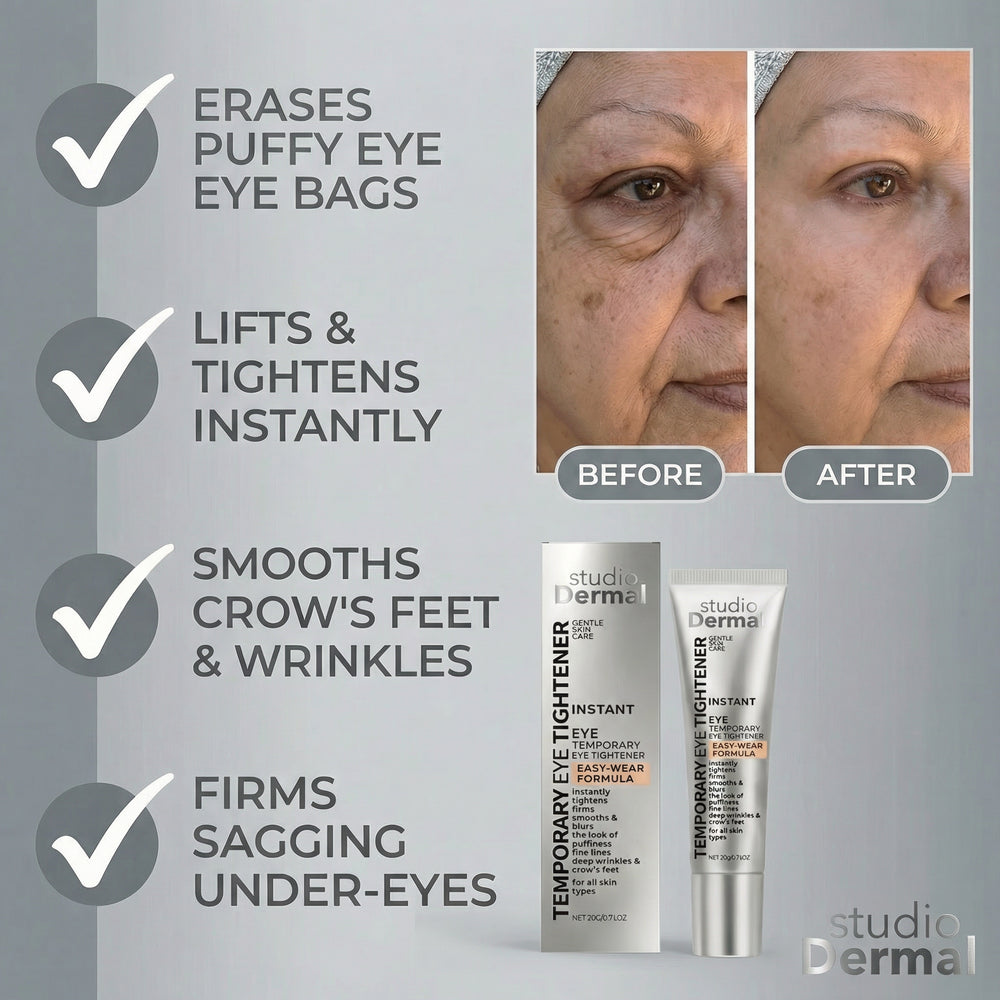
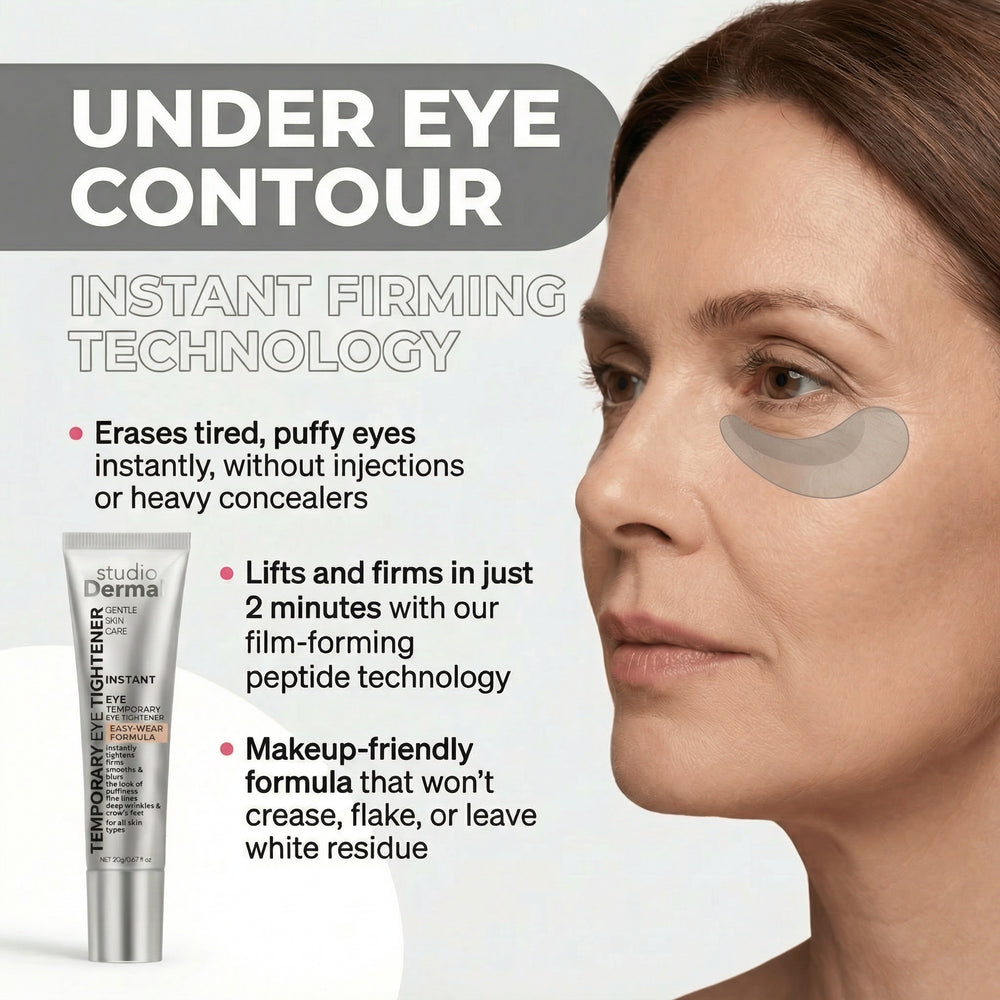
The thing I eventually landed on is not a moisturiser and does not behave like one. It is a tightening microfilm — a thin cosmetic layer that dries down across the under-eye and physically contracts as it sets, drawing slack skin taut in the same way a taut sheet flattens a rumpled mattress.
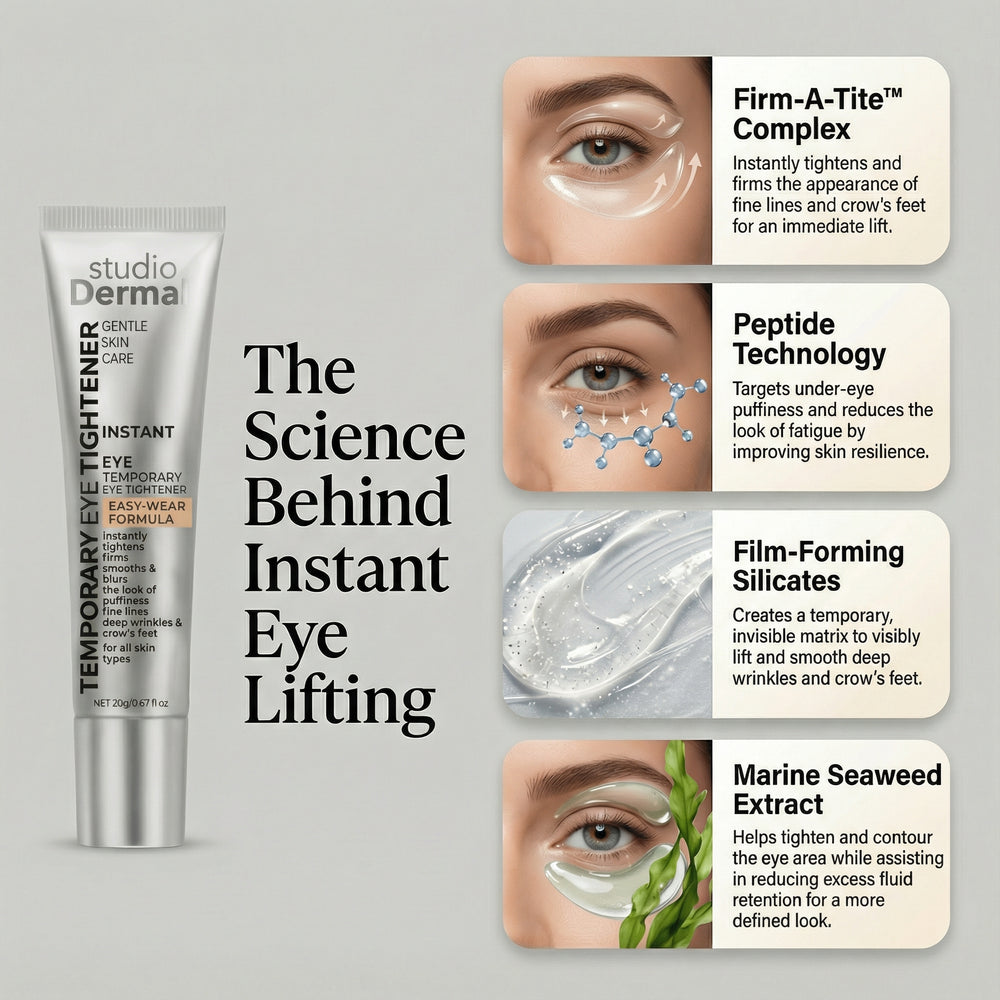
The mechanism is not exotic. It is film-forming silicates: magnesium aluminium silicate and sodium silicate suspended in a light emulsion. As the water evaporates, the silicate network knits together and shrinks by a small, controlled amount. That contraction has to go somewhere. It goes into the skin it is sitting on.
Here is what actually happens on your face, minute by minute. I timed it with the stopwatch on my phone the first time, because I did not believe the claim.
A pea-sized amount, on clean dry skin
Shake the tube, dispense roughly a pea, and press a genuinely thin layer under each eye, along the outer corner and up onto the brow bone. Dry skin only — oil and moisturiser sit between the film and the surface and stop it gripping. Never on the eyelid itself, and never in the eye.
You feel it draw
This is the strange part. As it dries you feel a distinct tightening sensation across the whole area — not unpleasant, but unmistakable. That is the silicate network contracting. Stay expressionless while it happens, because if you set it mid-smile it sets around the smile. Five minutes for a full, even hold; the visible change starts inside two.
Sheer, flexible, and makeup-compatible
The tint is skin-tone-adaptive, so it disappears rather than sitting on top as a pale cast. Once set you can apply concealer or foundation over it without pilling. The hold stays flexible — your face moves normally — and the brand rates it at up to sixteen hours. It washes off with your evening cleanse.
Underneath the film there are two peptides doing slower work — Dipeptide-2 and Palmitoyl Tetrapeptide-7 — alongside seaweed extract and vitamin E. Those are for skin resilience over time. The film is what you see in the mirror before you have finished brushing your hair.
Why This Is Not Sitting on Every Beauty Counter
I asked this question of everyone who would answer it, and the replies were consistent enough to be depressing.
The eye-care aisle is a repeat-purchase business. A jar of eye cream is designed to be finished and replaced, and the promise is always deferred: results in four weeks, results in eight weeks, keep going, be patient. That deferral is not a flaw in the model. It is the model. A customer who sees nothing but is told to wait eight weeks buys two jars.
Injectables run on the same logic with an extra zero. Six to twelve months of hold, then the appointment repeats, indefinitely, for as long as you care how you look in photographs.
A single tube that visibly changes the area in under two minutes does not fit either model. There is no eight-week story to tell. There is no follow-up appointment. You either look in the mirror and see it, or you send it back.
Nobody builds a marketing campaign around “you will know within ninety seconds whether this was worth your money.” It is far too easy for the customer to be right.
Ships from the official StudioDermal store
The Product: StudioDermal Reverse-Aging Eye Tightener
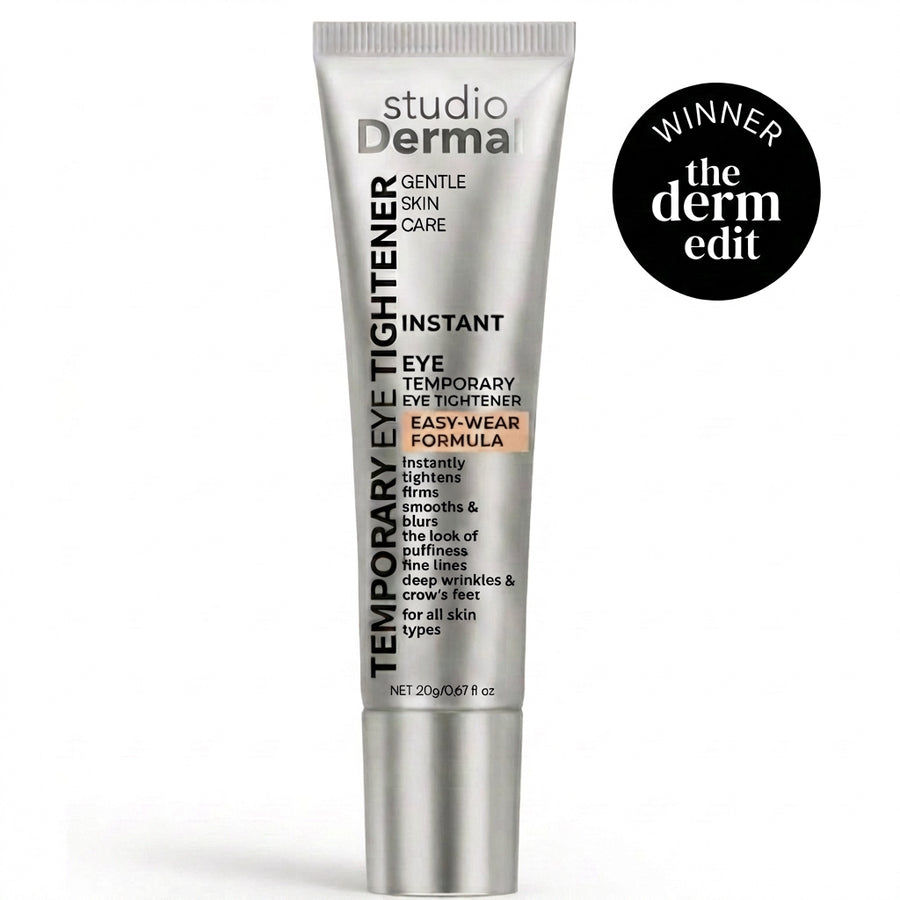
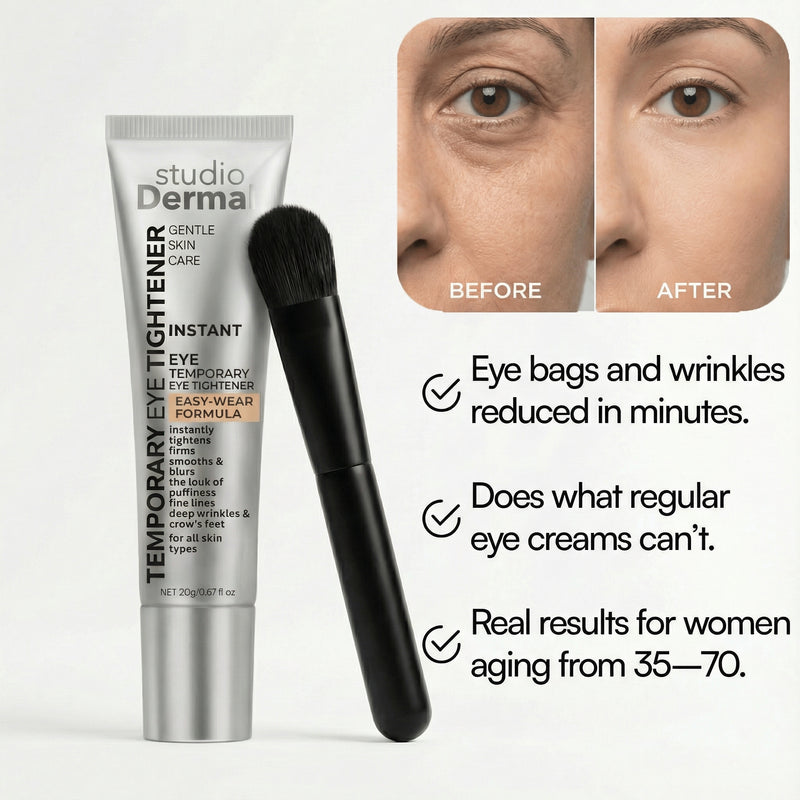
The version I use, and the one this article is about, is the StudioDermal Reverse-Aging Temporary Eye Tightener — a twenty-gram tube of the easy-wear formula. It is the one I tested against three cheaper film-forming products, and the only one that did not leave a chalky cast on me.
What is actually in the tube
- Film-forming silicate complex — the tightening microfilm that creates the visible lift as it dries.
- Dipeptide-2 and Palmitoyl Tetrapeptide-7 — peptides that support skin resilience with continued use.
- Seaweed extract and vitamin E — mineral-rich marine hydration and antioxidant barrier support.
- Sheer, skin-tone-adaptive tint — no white cast, no visible film, works across skin tones.
- Ophthalmologist-tested for use around the eye area. External use only — never on the lid itself.
- Rated for up to 16 hours of flexible hold, and compatible with concealer, foundation and powder once set.
- 20 g / 0.67 fl oz, formulated for mature skin from around 35 onward.
What Happened When I Actually Used It
I will be honest about the first attempt: I used far too much. Half the tube's worth of product across both eyes, a genuine schoolgirl error, and I ended up with a faint tackiness I had to dab off with a damp cotton bud. Less really is more with this. A pea. That is the whole instruction.
The second attempt, done properly, is the one I remember. I applied a thin layer, sat still for five minutes reading email, and then looked up.
The ridge was not gone. I want to be precise, because overpromising is exactly what got this category into trouble. The ridge was flatter, and the groove beneath it had lost its hard edge, and the crepe at the outer corner had smoothed into something that read as skin rather than tissue paper. The whole area sat higher. My eyes looked open.
My husband, who has never once commented on my skincare in fourteen years, asked whether I had slept well.
By the end of the first week I had worked out the practical details — that it goes on before everything else, that it needs the full five minutes, that concealer goes on top and stays there instead of sliding. By week three I had stopped choosing which side of a room to stand on. By week six I had a photograph of myself taken from the side, in bright afternoon light, that I actually liked.

Janet Beckwith, the dermatologist quoted on StudioDermal's own product page, makes the same argument in clinical language: in two decades of practice she has not seen a topical product physically lift the under-eye and neutralise darkness the way this combination of tightening microfilm and sheer tint does — and for patients who do not want injectables or surgery, she considers it the most effective non-clinical option she can point them toward.
Janet Beckwith, Dermatologist — as quoted on the manufacturer's product page.
What the Brand's Own Trial Reported
StudioDermal ran a small in-house study on thirty-nine women aged thirty-five to sixty-nine, each applying a single layer. These are participant-reported outcomes from that panel, and I am reproducing them as the manufacturer states them rather than as independent findings.
Manufacturer-reported outcomes from a 39-participant in-house panel. Individual results will vary.
Every participant in that panel showed some immediate improvement in the appearance of fine lines and deeper wrinkles — measured in minutes rather than weeks. That is a small sample and an in-house study, and you should weigh it accordingly. But it is at least testing the thing it claims to do, on the timescale it claims to do it, which is more than most of the eight-week promises in my bathroom cabinet ever managed.
- Free shipping
- Money-back guarantee
- No subscription
How To Use It Without Making My Mistakes
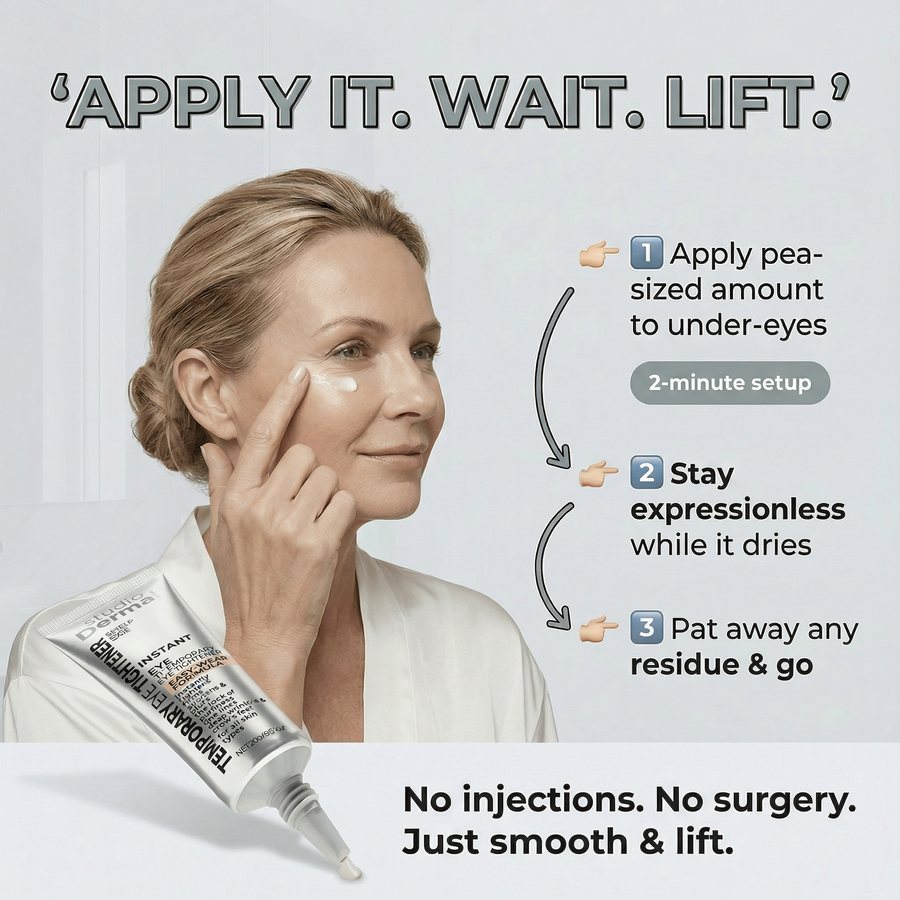
Start clean and completely dry
Cleanse the under-eye area and let it dry properly. Oils, serums and moisturiser all interfere with the film's ability to grip, which is the single most common reason people say it “did nothing.”
Shake the tube, dispense a pea
One pea-sized amount covers both eyes. With a fingertip or the applicator brush, press a thin, even layer under the eye, out across the crow's-feet area and up onto the brow bone. Avoid the lid, and keep it well clear of the eye itself.
Stay expressionless for five minutes
Genuinely still. No talking, no smiling, no reading anything funny. You will feel it draw tight as it sets — that is the film doing its job, and setting it around a neutral expression is what gives you a smooth result.
Dab off any residue
If you used slightly too much you may see a faint trace once it dries. A damp cotton bud, gently, takes it straight off. Next time use less — the formula is designed for minimal product.
Makeup over the top, then get on with your day
Once it is set you can apply concealer, foundation or powder without pilling or creasing. The hold is rated for up to sixteen hours and comes off with your normal evening cleanse.
What Readers Have Told Us
We mentioned this in a newsletter in the spring and the replies have not really stopped. A representative handful, lightly trimmed for length:

“I had a consultation booked for lower eyelid surgery and I cancelled it. Not because this is the same thing — it obviously is not — but because it turned out I could live perfectly happily with the result I get in two minutes each morning. My daughter noticed before I said a word.”

“Six video calls a day and that little self-view rectangle in the corner was quietly ruining my confidence. I use it before the first meeting. I no longer hide the self-view. That is the whole review.”

“Twenty years of nights have given me under-eyes that look like I am permanently recovering from something. First attempt I used too much and it went slightly tacky. Second attempt was right. I keep it in my locker now.”
“Four stars rather than five only because the five minutes of sitting still is genuinely difficult in my house. The result is exactly as described — the puffiness flattens and the shadow softens. It is not surgery and it does not pretend to be.”
The Three Ingredients Doing the Work

Film-forming silicates
The tightening microfilm. Contracts as it dries to visibly firm and smooth the skin it is sitting on.
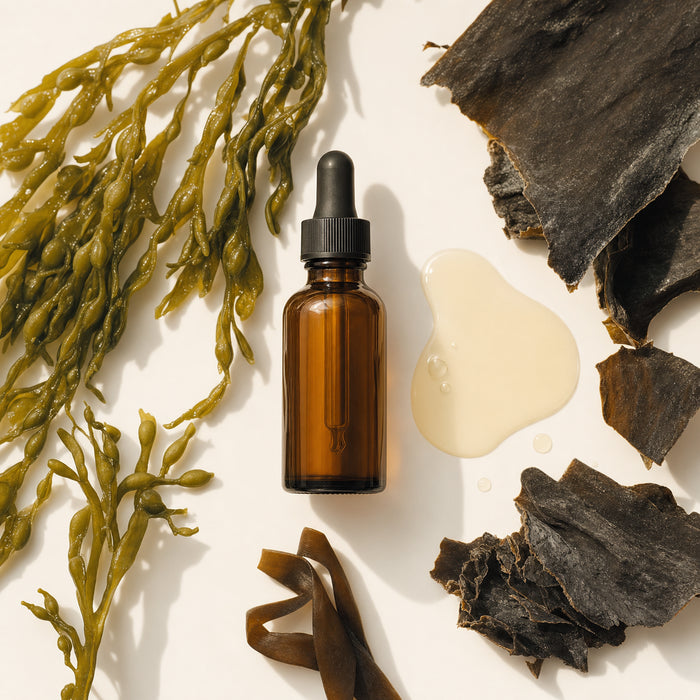
Seaweed extract
Mineral-rich marine algae that hydrates the area and helps the finish sit comfortably rather than tightly.

Vitamin E
Antioxidant support for a smoother, more resilient skin barrier in the most fragile area of the face.
Water, dimethicone/vinyl dimethicone crosspolymer, glycerin, dipeptide-2, laureth-3, magnesium aluminum silicate, propylene glycol, lactic acid, sodium silicate, polysorbate 80, C13-14 isoparaffin, butylene glycol, isohexadecane, 1,2-hexanediol, seaweed extract, magnolia obovata bark extract, magnolia biondii flower extract, hydrolyzed hibiscus esculentus extract, tocopheryl acetate, ethylhexylglycerin, citric acid, phenoxyethanol.
“Fine. But I Have Been Burned Before.”
Good. You should be sceptical — this is a category built on disappointment. Here are the questions readers actually send us, answered as plainly as I can manage.
Will it leave a white cast or go chalky under makeup?
This was my first worry, because older tightening formulas were notorious for it. Two things prevent it here:
- The tint is skin-tone-adaptive rather than a fixed shade, so it reads as skin rather than as a pale layer sitting on top of it.
- The easy-wear formula is designed for a very thin application. Almost every complaint about residue traces back to using too much product, which was exactly my own first mistake.
Can I wear concealer and foundation over the top?
Yes, once it has fully set — give it the full five minutes. Concealer, foundation and powder all sit on top without pilling or flaking, and because the film has flattened the ridge underneath, the concealer stops migrating into the groove and creasing. For me that was the single biggest practical improvement: makeup that still looks like makeup at four in the afternoon.
Is it safe for sensitive skin, and for mature skin?
It is ophthalmologist-tested for use around the eye area, and it was formulated specifically for skin from around thirty-five onward — thin, less elastic, prone to holding fluid. It is for external use around the eye only: never on the eyelid itself and never in the eye. As with anything new near your eyes, patch test on the inner forearm first, and if you have an active eye condition or you are under a dermatologist's care, ask them before you start.
Is this permanent? What happens when I stop?
It is not permanent, and the product name says so — it is a temporary eye tightener. The film holds for up to sixteen hours and comes off with your evening cleanse, and the following morning you are back where you started. The peptides underneath are working on longer-term resilience, but the visible lift is a daily cosmetic effect, not a structural cure. I would rather a product told me that honestly than sold me an eight-week promise it had no intention of keeping.
I have bought a dozen eye products. Why would this one be different?
Because it is not doing the same job. Every one of those dozen was adding moisture to skin whose problem was a loss of tension. This adds tension. You will know within about two minutes of your first application whether it works on your face — which is a far better deal than being told to be patient for eight weeks and then blaming yourself when nothing changes.
How long does one tube last?
The tube holds twenty grams and a single application uses roughly a pea for both eyes. Used daily, most people report getting a couple of months out of one tube; used for events, work days and photographs rather than every morning, considerably longer. The two-tube bundle exists for this reason — it works out substantially cheaper per tube and it removes the annoyance of running out.
What if it simply does not work on me?
Then you send it back and you get your money returned. StudioDermal's own line on it is that you can try it worry-free, and if the temporary eye tightener does not work for you, you get your money back. Read the current refund terms on their site before ordering so you know exactly what applies to you — but the practical point stands: the decision is reversible, and you find out in minutes, not months.

Try it worry-free
The manufacturer's position is straightforward: if the eye tightener does not work for you, you get your money back. Current terms, timeframes and the returns process are set out on the official StudioDermal store — check them at checkout so you know precisely where you stand.
Given that you will know whether it works on your own face inside a couple of minutes, that is a fairly small risk to take.
Let Us Talk Honestly About the Money
Before the price, here is what the alternatives actually cost. These are the going rates I was quoted or paid, and I suspect they will look familiar.
And here is the current pricing on the official store. There is a genuine promotional discount running — the regular list price is shown alongside it — and it applies at checkout without a code.
One tube
- 20 g / 0.67 fl oz easy-wear formula
- Free shipping
- One-off purchase — no subscription
Two tubes
- Two 20 g tubes — works out at $22.49 each
- Free applicator brush included
- Free mystery gift and free shipping
- One spare in the drawer — no running out mid-week
Prices, promotions and stock are set by StudioDermal and shown at checkout. Verify the current figure on their site before ordering.
Two Ways This Goes From Here
You close the tab
- Tomorrow's morning puffiness stays until lunchtime, as it did today
- The concealer keeps creasing into the groove by ten o'clock
- You keep buying a jar every four months on the eight-week promise
- You carry on choosing photographs by which side the light came from
- Stage two quietly becomes stage three, where topicals no longer reach
You try the tube
- Two minutes at the mirror, before anything else goes on
- You know whether it works on your face on day one, not in eight weeks
- Makeup that still looks intentional at four in the afternoon
- No needles, no downtime, nothing irreversible
- If it does nothing for you, it goes back and you are refunded
Ordering Takes About a Minute
Open the official store
The button below goes to StudioDermal's own product page over a secure connection. Nothing is bought on this site, and Dermal Stories never handles your payment details.
Pick one tube or two
The two-tube bundle is the one most readers take, largely because of the per-tube price and the free applicator brush. One tube is plenty if you simply want to find out whether it works on you.
Test it the morning it lands
Clean, dry skin. A pea. Five still minutes. You will have your answer before you have finished getting dressed — which is more than eleven years of eye cream ever gave me.
I am not going to tell you this changed my life, because it did not. It changed my mornings, which turns out to be a surprisingly large fraction of a life.
What I will say is this: I spent eleven years buying the wrong tool for the job because nobody ever explained to me what the job actually was. If this article did nothing else but explain the mechanism — slack skin, trapped fluid, lost tension — then it was worth writing, whether or not you ever buy anything.
But if you have been telling yourself for a couple of years now that it is not that bad yet, I would gently point out that this is exactly what I told myself, for four of them.
Nora F.
Beauty Desk · Dermal Stories · This article is an advertisement
StudioDermal Reverse-Aging Eye Tightener
$79.99$29.99
Go to the official store- Free shipping
- Money-back guarantee
- No subscription
- Ophthalmologist-tested
P.S. — Try this in front of a mirror now. Press a fingertip gently into the skin just below your lower lashes, hold it for two seconds, and let go. Time how long the dent takes to disappear. On skin with intact recoil it is instant. If yours takes a second or more to fill back in, that is the slack window, and it is the thing every eye cream in your cabinet was never built to address. See what does address it →
P.P.S. — The reason I keep returning to the two-minute timescale is that it removes the usual excuse. You are not committing to a routine or a regimen or eight weeks of faith. You apply it once, you look in the mirror, and you have your answer. Check availability →
P.P.P.S. — And if it does nothing for you, the manufacturer's position is that you get your money back. Read their current terms at checkout. The only genuinely expensive option here is the one where you spend another four years and another few thousand dollars on jars that were never designed to lift anything. Order from the official store →